Precision Agriculture in Ashburton: A Practical Guide for Canterbury Farmers
What if the key to cutting your fertiliser bill by 25% while complying with local 190kg N/ha nitrogen limits was already sitting in your effluent pond? For most dairy farm support operations in Ashburton, the soaring price of synthetic inputs and the constant pressure of regulatory compliance are heavy burdens to carry. You understand that managing a profitable farm in Mid Canterbury requires more than just long hours. It demands a smarter, more calculated approach to how you treat your soil and your equipment.
This guide demonstrates how adopting precision agriculture techniques, such as direct slurry injection and mechanical stone picking, can protect your bottom line. By working with a reliable local ag contractor to implement these systems, you can significantly reduce your reliance on expensive bagged fertiliser and prevent those NZ$8,000 repair bills caused by stray paddock stones hitting your harvester. We will provide a practical roadmap to help you achieve better pasture growth and a reduced environmental footprint, ensuring your operation stays ahead of local regulations while maintaining high standards of excellence.
Key Takeaways
- Discover how adopting precision agriculture allows Mid Canterbury farmers to move from blanket spreading to targeted application, significantly slashing fertiliser costs.
- Learn why direct slurry injection is the gold standard for local dairy farm support, ensuring nutrients reach the root zone while minimizing environmental waste.
- Understand how mechanical stone picking protects your high-value gear from costly “sheared pins” and ensures your paddocks are perfectly prepared for planting.
- Find out how modern machinery data logs provide the essential “proof of placement” required for ECan compliance and your Farm Environment Plan (FEP).
- Get a practical guide for choosing a local ag contractor in Ashburton who prioritizes reliability and uses specialized machinery to get the job done right.
What is Precision Agriculture in the Canterbury Context?
Farming in the Canterbury Plains is a game of margins and precision. It’s no longer about how much you can spread across a paddock; it’s about how accurately you can place every single grain of seed or gram of urea. What is Precision Agriculture essentially boils down to a “Right Rate, Right Place, Right Time” strategy. This method replaces the old-school approach of blanket spreading with a targeted system that respects the unique needs of every square metre of your land.
Ashburton farmers are currently leading this shift because the traditional “spray and pray” model doesn’t hold up under modern environmental regulations or rising input costs. Since 2022, the drive for efficiency has moved from a luxury to a necessity. A local ag contractor acts as the vital link in this process. They provide the specialized machinery and technical expertise required to turn complex soil maps into real-world results. Without the right gear, the best data in the world is just a file on a hard drive.
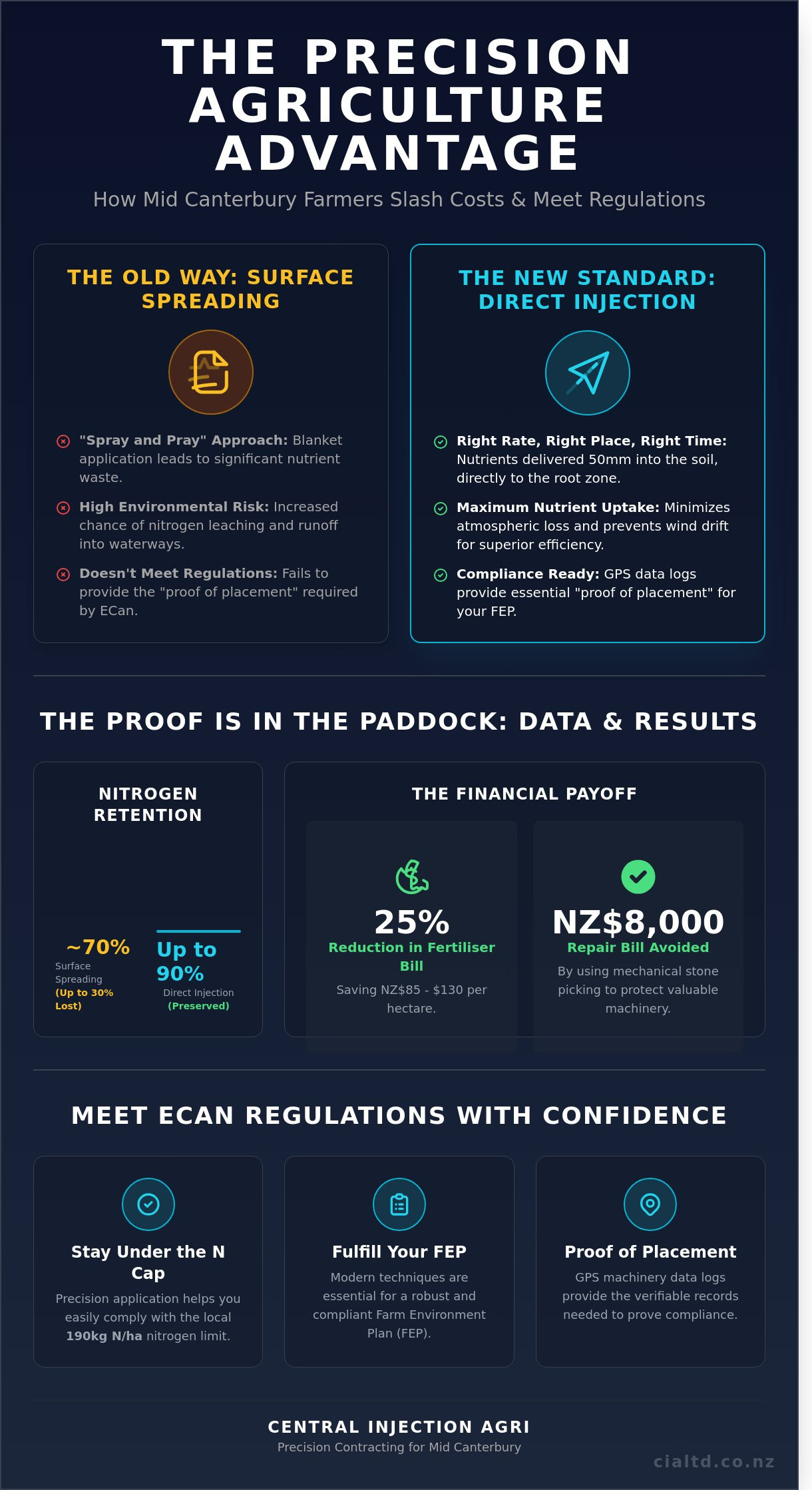
Adopting precision agriculture directly impacts your bank account by slashing waste. When you stop over-applying nutrients to areas that don’t need them, your overheads drop immediately. Local data from the 2023 season shows that Canterbury farms using variable rate technology saved between NZ$85 and NZ$130 per hectare on fertilizer alone. These savings aren’t just theoretical; they’re reflected in the improved bottom lines of operations throughout Mid Canterbury.
Beyond Drones: The Practical Side of Precision
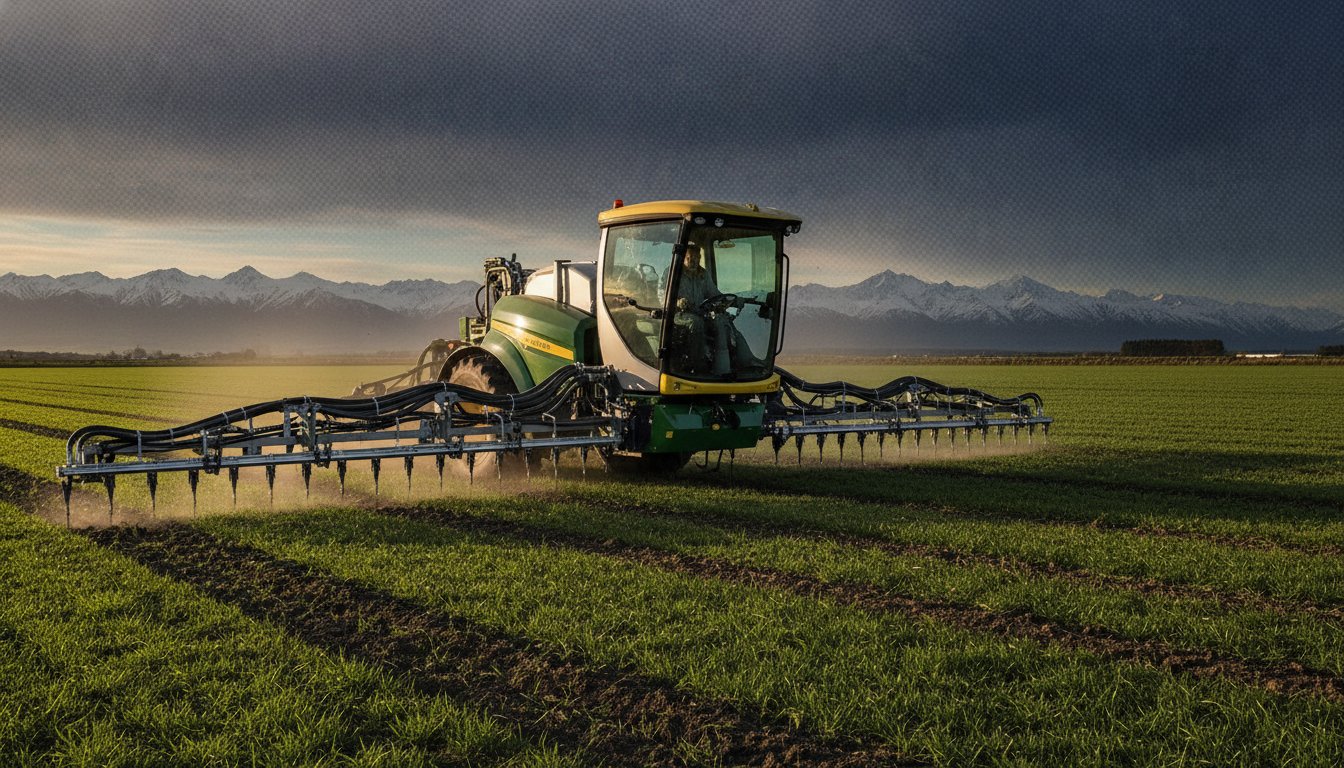
While drones get the headlines, the real work happens on the ground. GPS-guided machinery is now the baseline requirement for any reputable agricultural contractor in the region. The core of this technology is Variable Rate Application, or VRA. In simple terms, VRA is an automated system that adjusts the output of a spreader or seeder in real-time. It uses pre-loaded maps to ensure that thin soil gets more support while nutrient-rich zones aren’t overloaded. This moves your farm away from broad-acre guesswork toward centimetre-perfect nutrient delivery.
Why Mid Canterbury is the Ideal Proving Ground
The Canterbury Plains feature some of the most diverse soil profiles in New Zealand. You might find Lismore stony silt loams and deeper alluvial soils within the same boundary fence. These variations mean a single application rate is never the right choice. Dairy farm support operations in Ashburton and Rakaia face the added pressure of meeting strict nitrogen leaching caps. Precision tools allow these farmers to maintain high yields while staying well within their environmental limits. Our local climate, characterized by sudden Nor’wester winds, also makes the “Right Time” element critical. Having an ag contractor who understands local weather patterns ensures that products are applied when they’ll actually stay in the soil, rather than blowing into the next township.
Direct Slurry Injection: Precision Nutrient Management
Canterbury farming has shifted significantly in the last five years. Traditional methods no longer meet the strict environmental standards required by Environment Canterbury (ECan). Direct injection has emerged as the gold standard for precision agriculture in Mid Canterbury because it removes the guesswork from nutrient loading. While old-fashioned splash plates rely on gravity and hope, Vervaet injection machinery uses pressurized systems to place nutrients exactly where roots can access them. Putting slurry 50mm into the soil prevents the nitrogen loss that occurs when effluent sits on the surface.
The science of nitrogen retention is straightforward but vital for your bottom line. When you spread on top of the paddock, you can lose up to 30% of your nitrogen to the atmosphere within 24 hours. Direct injection preserves up to 90% of available nitrogen compared to surface spreading. This efficiency helps an Ashburton dairy farm support team stay well within nitrogen discharge caps while maximizing pasture growth. A 2023 report on the state of precision agriculture in New Zealand by the Foundation for Arable Research highlights how these technologies are becoming essential for regulatory compliance across the country.
The Vervaet Advantage for Local Farms
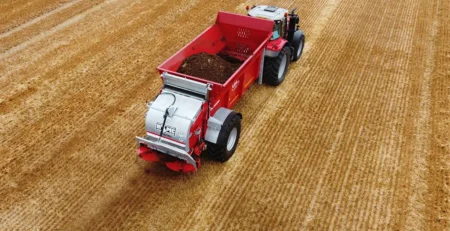
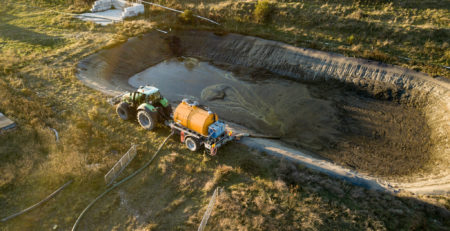
Vervaet machines are designed for the demanding conditions of South Canterbury. These high-capacity injectors use a “crab steer” configuration, meaning the rear wheels don’t follow the same tracks as the front. This clever weight distribution, combined with large flotation tyres, minimizes soil compaction even when the tank is full. Before any application begins, your local ag contractor will use pond stirring to ensure the slurry is fully homogenized. This step is critical; it ensures that the nutrient concentration remains consistent from the first litre to the last, preventing “hot spots” in your paddocks.
Measuring the ROI of Precision Spreading
The financial return on this technology is easy to track through reduced input costs. By utilizing injected slurry effectively, farmers in the Mackenzie Country and Timaru can reduce their synthetic urea purchases by 18% on average. At 2024 market prices, these savings directly improve the season’s margins. Beyond the numbers, there is the “odour factor” to consider. Because the slurry is placed underground, the ammonia smell is reduced by nearly 85%. This makes precision injection the only responsible choice for farms located near growing townships like Rangiora or Oxford. It is about maintaining your social license to operate while running a highly efficient business.
Precision is not just about the machinery; it’s about the infrastructure that supports it. If you need to upgrade your farm buildings or storage facilities to handle modern equipment, a reliable building partner can help you design a setup that works for the long term. Every agricultural contractor knows that the right setup on the ground makes the job faster and more accurate.
Adopting these methods ensures your farm remains productive under increasingly tight ECan nitrate leaching limits. By moving away from surface application, you’re not just following rules; you’re investing in the long-term health of your soil. It is a practical, grounded approach to precision agriculture that delivers results you can see in your pasture quality and your bank account.
Precision Land Prep: The Role of Stone Picking
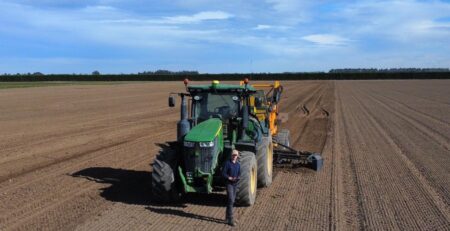
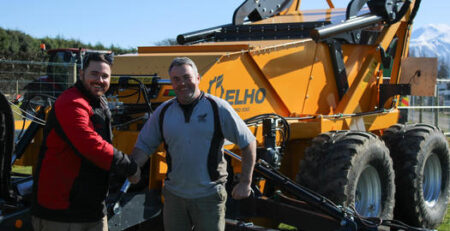
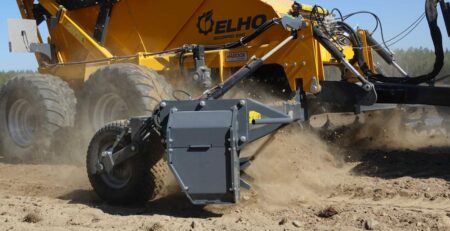
In Mid Canterbury, the success of your cropping cycle starts months before the seed hits the ground. If you’re investing in high-spec Precision Agriculture Techniques, you need a paddock that won’t fight back. Stone picking isn’t just about aesthetics; it’s a structural requirement for modern farming. A single river stone can derail a NZ$600,000 harvester in seconds. When a rock hits the internal components of a precision drill, it doesn’t just stop the machine. It throws off sensor calibration and ruins the uniform seed depth you’re paying for. In Ashburton, your local ag contractor uses ELHO Scorpio 550 pickers to handle these challenges. These machines clear rocks ranging from 25mm to 400mm in diameter, creating a level playing field for your technology to perform.
Mechanical rock removal ensures your precision seed drills maintain consistent soil contact. This is vital for even germination across the entire paddock. In the 2023 cropping cycle, 68% of growers in South Canterbury reported that stone-free paddocks led to a 12% increase in plant emergence uniformity. When the drill doesn’t bounce over obstacles, the coulters stay at the exact depth set by your GPS system. This level of accuracy is what separates a standard harvest from a high-performance yield. It’s about reliability and getting the job done right the first time, much like the precision required in seismic bracing or acoustic attenuation in a high-end build.
The hidden cost of “sheared pins” is a recurring nightmare for farmers from Timaru to North Canterbury. A sheared pin is a cheap part, but the ripple effect is expensive. If your harvester goes down during a critical 48-hour weather window in January, you’re losing more than just time. You’re looking at potential yield losses of 15% if the rain hits before you’re back online. Repairing internal damage to a baler can easily exceed NZ$8,500 in parts and specialized labor. By removing the threat before the season starts, you’re practicing a proactive form of precision agriculture that protects your bottom line.
Protecting Your Investment in Precision Gear
Modern harvesters and balers are packed with sensitive sensors that don’t tolerate impact. These components require a rock-free environment to function at their peak. During the 2023 season, Ashburton farmers reported that downtime due to rock ingestion cost an average of NZ$1,250 per hour in lost productivity. Engaging a stone picking contractor in Mid Canterbury protects your equipment from long-term depreciation. It keeps your gear in the paddock and out of the workshop. This focus on equipment integrity ensures your machinery lasts for more seasons with fewer emergency repairs.
Rock Raking vs. Picking: A Precision Approach
Choosing between raking and picking depends on your specific goals for the soil. Rock raking is ideal for gathering surface stones into windrows for easier collection. For deeper clearing in permanent pasture or intensive cropping cycles, mechanical picking is the superior choice. It reaches depths of 10cm to 15cm to clear the root zone. Before your local ag contractor arrives, graze the paddock down to the boards. This exposes the stones and allows the picker to work with maximum efficiency. Clean paddocks are especially critical in the Mackenzie Country and Twizel, where the soil profile can be notoriously unforgiving on gear. Proper prep ensures your precision drills operate with the seamless accuracy your farm demands.
Meeting ECan Regulations with Precision Technology
Navigating Environment Canterbury’s (ECan) Land and Water Regional Plan is a major focus for every producer in Mid Canterbury. Current rules around nitrate leaching and effluent management are strict. They require you to stay within specific nitrogen loss limits to protect our groundwater. Using precision agriculture transforms this regulatory burden into a streamlined process. Instead of manual records, you get automated data that proves your compliance instantly. It’s about having the right information at your fingertips when you need it most.
Precision data logs provide the “proof of placement” required for modern Farm Environment Plans (FEP). These digital records show exactly where, when, and how much nutrient was applied to a paddock. When an auditor visits your Ashburton or North Canterbury property, you can present a clear map rather than a stack of messy notebooks. This transparency builds trust with regulators and simplifies the auditing process. It moves the conversation from estimates to hard facts, which is essential for protecting your farm’s future.
Modern dairy farm support has shifted from simple labor to high-level technical compliance. Your local ag contractor now uses tools like the Dairy Effluent Storage Calculator to plan applications. This tool helps you decide when the soil is too saturated to receive nutrients, which prevents leaching. It’s a proactive way to manage your storage ponds while staying on the right side of the law. Relying on an Ag contractor who understands these metrics is essential for maintaining your farm’s operational integrity and avoiding costly mistakes.
Steps to Achieve Regulatory Compliance
Achieving compliance in South Canterbury requires a methodical approach to nutrient application. Start with accurate pond stirring for at least 4 hours to ensure your effluent is a consistent slurry. This makes your nutrient analysis reliable and prevents heavy solids from settling at the bottom. Next, use calibrated injection systems to meet specific kg/N/ha requirements. This precision ensures you don’t over-apply in one area while starving another. Digital mapping then captures the GPS coordinates of every application. Finally, regular soil testing every two years validates that your strategy is working, providing the data needed to adjust for the next season with confidence.
Future-Proofing Your Farm for 2026 and Beyond
Stricter water quality standards are coming for the Mackenzie Country and Timaru by 2026. Waiting until these rules are enforced is a risky strategy that could lead to unnecessary stress. Investing in a professional agricultural contractor who uses precision tech now saves you from potential compliance fines later. These fines can reach thousands of dollars for a single breach. Beyond the money, using these methods protects your social license to farm. The public in Twizel and across Canterbury wants to see responsible land stewardship. Precision tools provide the evidence that you’re doing the right thing for the land and the local community, ensuring your farm remains a respected part of the landscape for generations.
Choosing the Right Local Ag Contractor in Ashburton
Selecting an agricultural contractor in Mid Canterbury requires more than just finding someone with a tractor and a spare afternoon. As farming systems become more complex, your choice of partner directly impacts your bottom line. You need a team that views precision agriculture as a standard operating procedure rather than an optional extra. A precision-focused contractor doesn’t just spread or pick; they use data to ensure every pass is efficient and every input is optimized for your specific paddock conditions.
Modern, well-maintained machinery is a non-negotiable part of this equation. We invest in high-spec gear like Vervaet self-propelled slurry tankers and ELHO stone pickers because they deliver results that older, budget equipment simply can’t match. For instance, our Vervaet systems use onboard flow meters and GPS integration to apply effluent with pinpoint accuracy. This prevents over-application in sensitive areas and ensures you’re getting the most nutrient value out of your slurry. When you hire a local ag contractor, you aren’t just paying for the machine; you’re paying for the technology that protects your soil structure and maximizes crop yields.
Local knowledge remains your greatest asset. An Ashburton-based firm understands the unique transition from the heavy coastal silts to the stony ground found near the foothills. We know how the wind affects application patterns and how the moisture levels in Mayfield differ from those in Mt Somers on any given day in October. This regional expertise allows us to adjust our approach on the fly, ensuring the job gets done right the first time without wasting resources or damaging your land.
The Central Injection Agri Difference
Central Injection Agri stands apart through a “get the job done right” attitude that defines our NZ-owned heritage. We don’t believe in cutting corners, especially when it involves the long-term health of your farm. Our service model focuses on a specialized triad: slurry injection, compost spreading, and stone management. By mastering these three pillars, we provide superior dairy farm support to growers throughout Mid Canterbury. Whether we are working on a large-scale conversion or providing seasonal maintenance, our focus remains on reliability and high-standard craftsmanship. We treat your land with the same respect we give our own, utilizing bespoke solutions that fit your specific topographical challenges.
Booking Your Seasonal Precision Support
Timing is everything in the Canterbury farming calendar. To get the most out of precision agriculture, you should coordinate your slurry injection and stone picking well in advance of your primary planting windows. Most farmers find that late winter and early spring are the most effective times for slurry work to boost soil nutrients before the growth surge. For stone picking, the window following cultivation but prior to drilling is critical to protect your following harvest equipment.
Our team works closely with you to integrate our services into your existing schedule, minimizing downtime and ensuring seamless transitions between phases of work. You can contact us today to discuss your requirements and receive a customized quote for our Slurry Injection Services. Planning ahead ensures you secure the high-spec machinery needed to maintain your farm’s productivity during the busiest weeks of the year.
Future-Proof Your Canterbury Farming Operation
Adopting smarter farming practices is the best way to stay competitive in today’s market. By utilizing precision agriculture, you can achieve up to 80% better nitrogen retention through direct slurry injection while staying fully compliant with ECan environmental regulations. Our approach combines specialized local knowledge of Ashburton soils with high-performance machinery like the Vervaet applicator and ELHO Scorpio stone picker. This technology ensures your land preparation is thorough and your nutrient management is exact. As a 100% NZ owned and operated local ag contractor, we understand the specific challenges of Mid Canterbury and South Canterbury landscapes. We prioritize reliability and high standards to help you get the best return from every hectare. You’ve built your farm on hard work. Let’s use the right tools to keep it thriving for the next generation. It’s time to streamline your dairy farm support and see the difference that expert local knowledge makes to your soil health.
Get a Precision Ag Quote from Your Local Ashburton Contractors
Frequently Asked Questions
What is the main benefit of precision agriculture for a dairy farmer?
The primary advantage of precision agriculture for your dairy operation is the significant reduction in input waste, which typically lowers costs by 15% per season. By using GPS-guided systems, your local ag contractor applies nutrients only where the soil requires them. This targeted approach maximizes pasture growth across every hectare while ensuring you don’t overspend on unnecessary bulk fertilizers.
Does precision slurry injection really save money on fertiliser?
Precision slurry injection saves substantial money by reducing your reliance on synthetic nitrogen by 25% to 30%. Unlike traditional spreading, this method places nutrients 50mm below the surface to prevent ammonia loss. It’s a practical way to use your own farm’s effluent as a high-value resource, keeping more money in your pocket instead of spending it on imported urea.
How much does it cost to hire a stone picking contractor in Ashburton?
Hiring a stone picking contractor in the Ashburton area generally costs between NZ$250 and NZ$350 per hour. For a standard 10 hectare paddock in Mid Canterbury, you should plan for approximately 5 hours of machine time. These rates include a high-capacity picker and an experienced operator who understands the specific soil challenges found in the Canterbury Plains.
Can precision agriculture help with ECan nitrate compliance?
Precision agriculture is a vital tool for staying within the 190kg N/ha/year synthetic nitrogen cap mandated by Environment Canterbury. Our systems generate digital proof of placement maps that show exactly where and how much nutrient was applied to your land. You can hand these precise records directly to auditors during your Farm Environment Plan (FEP) reviews to prove total compliance.
What is the difference between splash plate spreading and direct injection?
The difference lies in nutrient retention; splash plates spray effluent into the air while direct injection places it safely underground. A splash plate can lose up to 80% of its nitrogen to the atmosphere on a typical 20 degree day in Timaru. Direct injection eliminates this evaporation, ensuring the grass roots receive the full benefit of the application immediately.
Do I need my own GPS data to use your precision contracting services?
You don’t need to provide any existing GPS data to utilize our dairy farm support services. Our fleet uses integrated RTK-GPS technology that maps your boundaries with 2cm accuracy as we work. If you already use a platform like FarmIQ, we can easily import those files to ensure our agricultural contractor team respects your specific exclusion zones and paddock lines.
What areas of Canterbury do you provide dairy farm support for?
We provide reliable dairy farm support throughout Mid Canterbury and South Canterbury, covering the entire region from the Rakaia River to the Waitaki. Our teams are frequently active in Ashburton, Timaru, and the Mackenzie Country. As a New Zealand owned and operated business, we’re committed to helping farmers from North Canterbury down to Twizel achieve better results.
Is stone picking worth it for permanent pasture?
Stone picking is a smart investment for permanent pasture because it prevents expensive breakdowns for your mowing and harvesting gear. Removing rocks larger than 50mm improves seed-to-soil contact, which increases your grass strike rate by roughly 12% during renovation. It’s a foundational task that protects your machinery and ensures a level, productive surface for the next 10 years.